AI in Esports Betting: Can Algorithms Really Predict the Game?


Esports and chaos go hand in hand, especially for players in Singapore looking to bet. One week, a team is dominating, the next, they’re getting swept. The meta shifts overnight, balance patches rewrite power dynamics, and player performance can vary wildly match to match. In such a volatile environment, it’s no surprise that both platforms and bettors are seeking something to anchor their decisions, and increasingly, that anchor is artificial intelligence.
The combination of AI and esports is happening now because both worlds share a common language: data. Esports generates massive, structured datasets, from kill counts to pick-ban rates, at a pace that far exceeds that of traditional sports. At the same time, AI systems thrive on fast, repeatable inputs.Betting platforms use this to adjust lines and detect patterns; bettors use it to uncover edges and simulate matchups. It’s a natural collision of high-frequency data and machine learning.
But in a space where unpredictability is part of the appeal, the question remains: can AI actually give you an edge in esports betting in Singapore, or is it just high-tech guesswork dressed up as strategy? Let’s break down what AI is doing in esports betting right now, how it works, where it fails, and how to use it wisely without falling into the trap of blind trust.
How Esports Platforms Leverage AI for Singaporean Bettors
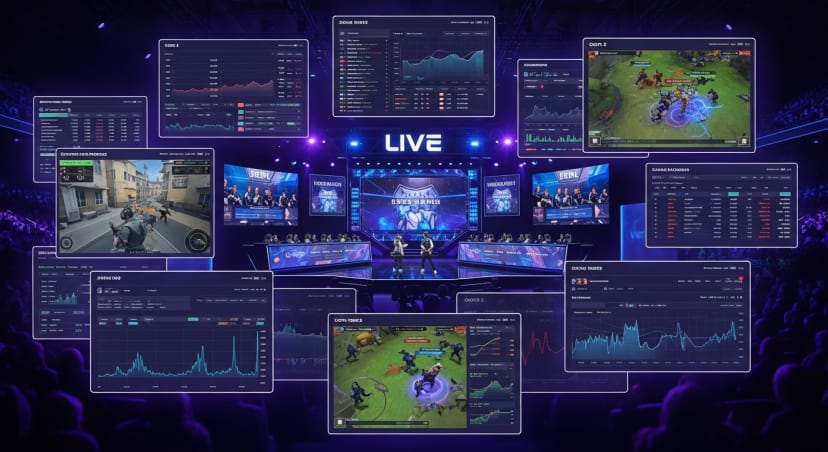
Esportsbooks use AI to analyze massive volumes of match data and adjust betting lines in real time. Models track map win rates, draft trends, tempo shifts, and patch impact to simulate thousands of possible outcomes. This helps platforms price odds more efficiently, manage risk, and detect suspicious betting behavior. Unlike traditional sports, esports generates faster, deeper data, which makes AI integration not just useful, but necessary for platforms catering to the Singapore market. Whether it’s League of Legends or CS2, AI is now quietly running behind the odds you see, helping platforms keep up with the speed and complexity of modern esports.
How Players in Singapore Can Use AI in Esports Betting
Players utilize AI to identify market inefficiencies, compare sportsbook lines, and analyze team data more efficiently than manual research allows. Some use third-party prediction tools, while others build their own models, trained on kill stats, draft patterns, or map histories. AI flags possible value bets or anomalies, but sharp bettors still validate those insights with contextual knowledge. The goal isn’t blind prediction; it’s informed filtering. With fast-moving tournaments and patch cycles, AI provides bettors with a way to stay ahead, not by guaranteeing outcomes, but by narrowing their focus and adding structure to an otherwise volatile betting landscape. This is particularly helpful for Singaporean players navigating the diverse esports scene.
What’s Actually Powering These AI Predictions in Esports?
Most AI tools in esports betting rely on some combination of machine learning models. These models are trained to process thousands of data points from past matches, then apply those learnings to current and future matchups.
The most common approach is supervised learning, where historical data, like kills, map bans, and win rates, is used to train a model to predict likely outcomes. Neural networks can also be employed to evaluate more complex relationships, such as how different champion matchups influence lane control or how economy management correlates with win rates on specific maps.
Some models even simulate thousands of potential outcomes, offering insights that can expose weaknesses across different types of bets in esports, especially when odds are slow to adjust. In theory, this gives bettors a chance to spot favorable matchups or market inefficiencies, but only if they understand the model’s logic and limitations.
AI Esports Betting: Pro & Cons
Despite the buzz, AI in esports betting has real and unavoidable weaknesses. First, there’s the pace of change. Esports titles are patched constantly. A single update can redefine win conditions, invalidate previous data, and scramble team strategies overnight. Models trained on yesterday’s data can’t adjust instantly.
Second, there’s the human factor. Algorithms can’t read tilt, overconfidence, or burnout. They can’t account for a player losing form after a long travel schedule or underperforming in front of a live crowd. These are intangibles, and they matter just as much as stats.
And then there’s data inconsistency. Not all regions or teams generate structured, complete datasets. Some lower-tier matches are poorly documented. Roster swaps, role changes, or mid-split substitutions may not be reflected until after the results are in. Incomplete inputs lead to incomplete predictions.
The primary benefits of AI in esports betting are speed and scale. It can process massive volumes of match data, such as kill statistics, agent picks, and map trends, far faster than any human can. AI helps bettors and platforms surface trends, flag value opportunities, and reduce emotional bias. It’s not about certainty; it’s about clarity in a fast-moving, data-heavy space. When used correctly, it turns noise into a signal.
Ultimately, an AI model is only as good as the data it’s trained on, and in esports, that data is frequently noisy, fast-changing, or incomplete.
| Pros | Cons |
| Analyzes huge datasets quickly | Can’t adapt instantly to patch changes |
| Detects trends and value bets early | Doesn’t account for player psychology |
| Adds discipline, reduces emotional bias | Relies on incomplete/inconsistent data |
| Enhances decision-making, not replaces it | Models degrade fast in volatile metas |
How to Use AI Betting Tools Without Getting Burned
If you’re betting on esports with AI assistance, the smartest thing you can do is treat it as a tool, not a shortcut.
Use models to identify matchups that appear off or to uncover long-term trends in team performance. Let AI highlight potential value, then do the work to validate that insight. Did a team’s win rate spike because of a favorable patch? Has a recent roster move altered the play style in a way that the model isn’t yet accounting for?
The key is knowing when to trust the data and when to trust your instincts. Follow the patch cycle. Watch games. Track map picks and drafting patterns. AI can help you see faster, but it can’t see everything. And when the stakes rise, playoff matches, LAN finals, high-pressure series, it’s often the human side of the game that decides outcomes, not statistics.
When used correctly, tools and analytics for esports betting can help you identify value, but they should never replace your understanding of the scene.
Final Take: AI Is the Edge, Not the Answer
AI isn’t going to hand you guaranteed wins. It can’t outguess every patch, every role swap, or every flash of brilliance from a star player. However, when used wisely, it can help you become a more informed and disciplined bettor.
Think of it like this: the model gets you halfway. It spots the opening. Your job is to confirm the angle, double-check the assumptions, and time the move.
The future of esports betting isn’t AI replacing bettors, it’s AI enhancing them. If you stay sharp, stay skeptical, and combine these tools with advanced esports betting strategies, you'll have an edge no model can replicate.
FAQ
What role does AI play in esports betting in Singapore?
AI analyzes extensive esports data—like kill/death ratios, hero pick rates, and map strategies—to help sportsbooks set real-time odds and assist Singaporean bettors in identifying value by spotting patterns and simulating match outcomes. It adds speed and structure to the fast-paced betting environment.
How do esports platforms use AI to set odds for Singaporean bettors?
Platforms use AI models that track factors such as map win percentages, drafting strategies, tempo changes, and patch updates to simulate thousands of potential outcomes. This allows for more accurate odds, better risk management, and detection of unusual betting patterns.
How can bettors in Singapore leverage AI in their esports wagering?
Bettors can use AI-powered tools to identify market inefficiencies, compare sportsbook odds, and analyze team data more efficiently than manual research. However, experienced bettors should validate AI-generated insights with their own knowledge rather than blindly trusting predictions.
What types of AI models power esports betting predictions?
Most models use supervised machine learning trained on historical data—kills, bans, win rates—and sometimes neural networks to analyze complex relationships like hero matchups or resource management. Some simulate thousands of match outcomes to find favorable betting opportunities.
What are the main advantages of using AI in esports betting for Singaporean players?
AI can quickly process large datasets, identify emerging trends and valuable bets early, reduce emotional bias, and add discipline to decision-making. It provides clarity in a fast-moving, data-rich environment but doesn't guarantee wins. Remember to gamble responsibly.
What are the limitations of AI in esports betting?
AI struggles to adapt instantly to frequent patch changes, cannot account for human factors like player psychology, tilt, or burnout, and depends on often incomplete or inconsistent data, especially from less prominent matches or regions.
How should bettors in Singapore use AI tools to avoid pitfalls?
Treat AI as an analytical tool, not a guaranteed win. Use it to highlight interesting matchups or trends, then confirm with patch notes, roster changes, and live game observations. Combining AI insights with your own judgment is key.
Can AI replace the human element in esports betting?
No. While AI offers speed and data-processing advantages, esports outcomes often depend on intangible human factors like player form, team morale, and strategic adjustments that models can't fully understand.
What is the best mindset when using AI in esports betting in Singapore?
See AI as a tool that helps you find potential bets by identifying opportunities. Your role is to validate those opportunities, understand the context, and time your bets accordingly. The future is in AI-assisted, not AI-dominated, betting.